
How to Choose Fresh Cut Flower Packaging
The right fresh cut flower packaging should suit your flowers, your customer’s journey and the way you work. Before you choose a finish, consider fit, moisture, presentation and the cost of putting the whole package together. Use the steps below to work through those choices for shop pickup and local delivery.
1 Start with the handoff
Write down how your customer will receive and carry the flowers. A bouquet collected at your counter may need an easy grip and a neat finish. A local delivery order also needs a clear plan for how the complete package will be held in the vehicle and passed to the recipient.
Record the expected time between packing and handover, and whether the flowers must remain upright. These are requirements to discuss with your supplier, not proof that a particular bag or box can meet them. For parcel shipping, ask for packaging assessed for that route; a gift package alone does not establish shipping suitability.
Think about the occasion too. A small thank-you gift and a large celebration bouquet may need different carrying space and presentation. If the recipient will open the package at an office or event, make sure they can set it down and reach the flowers without needing to dismantle layers of decoration.
2 Measure the complete bouquet
Build a representative bouquet with the wrap, stem tie and water container you intend to use. Measure its overall height and widest point, then the space needed around the stem base. Keep the flower heads clear of any opening or lid that could press against them.
Compare those measurements with usable internal dimensions. Ask whether a quoted size describes the outside, inside, opening or base. For tapered bags, check both the opening and the narrower base. Leave room for your fingers at the handles and for the bouquet to be removed without pulling petals against an edge.
Pay attention to the flower shape as well as the measurements. A wide, open bouquet needs room around its outer blooms; long stems need enough support below. Try the package with your most delicate or projecting flowers so that a neat fit does not become a tight fit.

3 Plan water handling before the outer finish
Decide how your flowers will receive water during the planned journey. Depending on the design, you may use a suitable inner vessel, water tubes for individual stems, or a purpose-made hydration wrap. Follow the instructions for the system you choose and include it when you check the packaging size.
Keep the wet component contained so that it does not soak the decorative wrap, bag base or message card. Ask what a waterproof or water-resistant description covers: the sheet material, coating, seams or assembled item. Check the complete setup with the actual water method; a material name is not a leak test.
Consider the conditions along the route, including rain at handover and moisture inside a closed package. Ask whether the specific design needs ventilation; do not add holes as a general solution. Packaging also needs to work with your flower-care routine and delivery timing, rather than replace them.
4 Match the material to the job
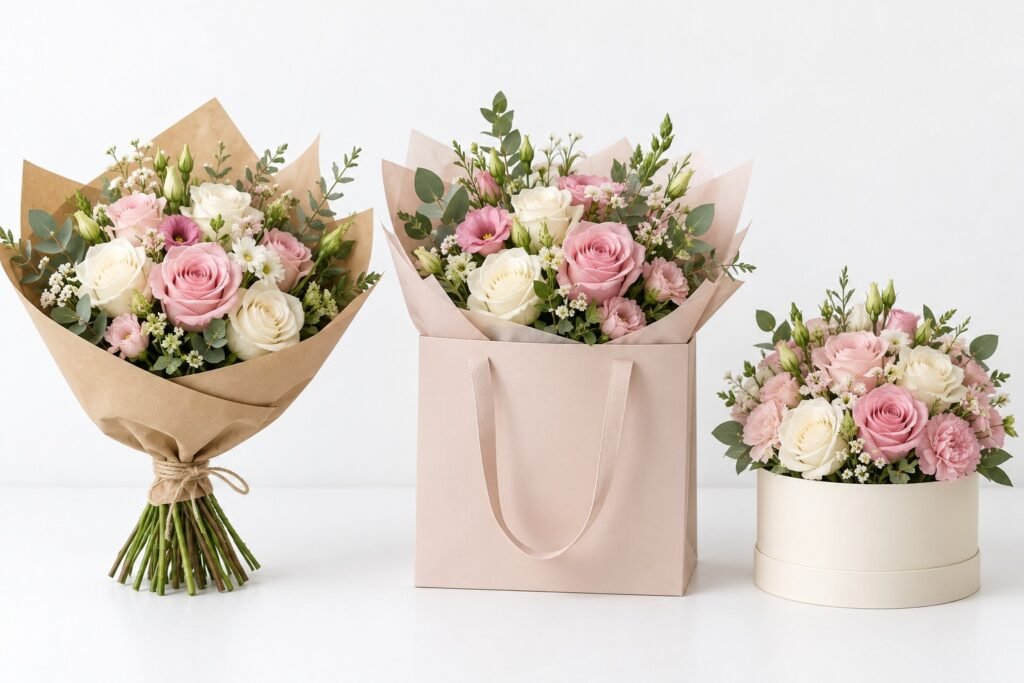
Once you know the size and water setup, choose materials for the job each layer needs to do. Kraft paper gives you an opaque outer wrap and a simple, natural-looking finish. Check how the actual sheet folds, whether it has a coating and how it responds to contact with moisture. A brown paper appearance alone does not establish its environmental credentials.
Transparent film lets you show more of the bouquet. If you are considering polypropylene (PP) film, confirm the polymer and finish in the product specification. Ask what any water-resistant description covers, and check the assembled package separately. Mesh, nonwoven fabric, jute and organza offer other decorative textures; use them where the effect adds something to your design, rather than adding every layer available.
For a bag or box, look beyond the surface. Check the base, handle attachments, joints and any insert with the actual bouquet inside. Corrugated board can be an option for an outer delivery carton, but its grade and internal support still need to match the load and route. A decorative paperboard flower box and a transit carton serve different jobs, even when both are described as boxes.

5 Tailor the packaging to your customer
With the practical requirements clear, tailor the package to how your customer will use it. For shop pickup, prioritize a comfortable grip and a bouquet that is easy to carry. For a corporate gift, you may need a company color, a personal message or space for a card. Choose the details that serve the order, then bring them together with your shop’s style.
Customization can start with ribbon, a label or a message card. If you choose printed packaging, consider what the recipient sees outside and after opening: a simple outer logo can identify your shop, while an inner pattern or message can carry the gift theme. Keep the flowers visible, the opening easy to find and care instructions accessible. For a closed box, ask whether a pull tab or tear strip would make opening easier without affecting protection.
Share these needs with your supplier before approving the design. Confirm which sizes, print areas and finishes are available for the item, along with the minimum quantity and production timing. Review a sample with the actual bouquet and card so that the personal touches work in use as well as in the artwork.

6 Check what happens after unwrapping
Review whether each layer is needed for protection, handling or presentation. Removing a purely decorative extra layer may simplify your package, but keep the parts that contain water or support the flowers. Ask for the composition of coatings, liners and inserts as well as the main material before describing the complete package as recyclable.
If you need FSC-certified paper packaging or a specified recycled content percentage, request documentation for the exact product. Use only claims that the evidence supports. Give your customer clear instructions for separating the components and checking local disposal guidance; do not assume that paper, film and ribbon all belong in the same collection stream.

7 Compare the cost of a packed order
Compare quotes for the same complete setup, not just the outer bag or box. Include the wrap, ribbon, insert and any extra supplies you actually need. Then time a few normal packing runs. A lower unit price may be less useful if the package repeatedly needs extra tape, adjustment or replacement sheets.
Ask how the packaging arrives and how much space it takes before use. Compare flat-packed and assembled options where available, including the work needed to prepare them. Check order quantities, setup charges and inbound freight. For parcel orders, confirm the carrier’s current size and weight pricing for the finished package before choosing a larger carton.

8 Try the sample as a complete package
Set up a short trial using your normal bouquet and intended packing method. Check a larger version too if you plan to use one package across several bouquet sizes. Note where the fit changes, rather than assuming a sample that works once will suit every order.
Have your usual packer assemble it, then walk through carrying, setting it down and opening it. Watch for shifting flowers, damp areas, uncomfortable handles and snagged petals. Include the message card and care information. Record packing time and any changes needed, then repeat with the revised sample. This is a practical trial, not a certified transport test.
Use your trial notes to prepare an inquiry. Include what you have measured and flag anything your supplier still needs to confirm.
Your packaging inquiry checklist
Item | Details to provide |
Use | Pickup or local delivery; intended upright position; expected handover time |
Fit | Complete bouquet measurements; required opening, base and usable height |
Water method | Inner vessel, individual tubes or hydration wrap; space and containment needs |
Product details | Category or SKU; exact material, finish and color; sample changes to confirm |
Quantity | Required amount and whether the quoted unit is a piece, set or carton |
Presentation | Color reference; card placement; print needs and approval sample |
Purchase conditions | Complete contents; quote units; packing format; documented material claims |
Discuss your packaging requirements
Ready to narrow your choices? Explore FloralMate’s flower wrapping, flower bags and flower boxes, then send an inquiry with your bouquet measurements, handover needs and expected quantity. Include your water method and any print or material requirements so you can confirm the details before choosing a final specification.
Frequently asked questions
Should I approve the color before checking the fit?
Check color and fit separately. Use a physical color sample alongside your flowers and wrap in your usual lighting; screen images are only a starting point.
How should I compare two similar packaging samples?
Pack the same bouquet with the same water method in each sample. Record differences in fit and handling so your comparison is consistent.
Does heavier paper always make a better package?
No. Paper weight alone does not describe the finished package. Check the base, handle attachments and performance with your actual contents and moisture exposure.
Should I add ventilation holes myself?
Ask whether your specific design and route need ventilation. Extra holes are not a universal fix and can change the package structure.
What if a sample differs from the product listing?
Photograph the difference and ask your supplier which specification applies. Confirm the material, dimensions or construction in writing before treating that sample as your reference.